 Texas Accident & Injury News


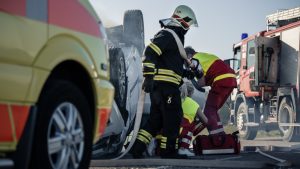
Rollover accidents often have catestrophic consequences.
26-Year-Old Man Hospitalized After Rollover Crash on Loop 410
According to a KSAT News report, a 26-year-old man was hospitalized after a rollover accident along Loop 410.¹
Police reported the accident happened at around 1 a.m. Tuesday, August 25th, along Loop 410 near Callaghan Road.
Investigators say the man suddenly swerved into the rear of another vehicle traveling in the same direction and then lost control. His vehicle spun out, struck the other vehicle a second time, and rolled over.
Police arrived to find the 26-year-old driver outside of his vehicle. He was taken to the hospital with non-life-threatening injuries.
No information was reported about the condition of the other vehicle or its occupants.
The investigation is ongoing.
Did You Know?
According to TxDOT data, faulty evasive action contributed to 19,958 crashes across Texas in 2024.²
How to Protect Yourself From Late-Night Accidents
Driving late at night can feel easier than navigating San Antonio during rush hour. There are fewer cars, less congestion, and usually fewer delays.
But an emptier highway isn’t necessarily a safer one.
Darkness makes hazards harder to see, while fatigue, impaired driving, and higher speeds can make other motorists less predictable. When something goes wrong, drivers may also have less time to recognize the danger and react safely.
If you regularly drive late at night, a few extra precautions can help reduce your risk.
Don’t Let an Empty Highway Encourage You to Speed
When traffic disappears, it’s easy to let your speed creep upward without realizing it.
That becomes more dangerous at night because your headlights can illuminate only a limited distance ahead. By the time you recognize a stalled vehicle, debris, an animal, or another unexpected hazard, you may have much less room to stop than you expected.
Keep an eye on your speedometer, particularly on wide-open highways where there are fewer surrounding vehicles to help you judge your speed.
Give Other Drivers More Space
At 1 a.m., you have no way of knowing whether the person in the next lane is tired, distracted, impaired, or simply about to make a mistake.
Leaving additional space around your vehicle gives you more time and more options if another driver suddenly brakes, changes lanes, swerves, or loses control.
That means more than increasing your following distance. When possible, avoid lingering directly beside another vehicle. Either move ahead safely or fall back so that you have room to react if the other driver moves unexpectedly.
Creating that extra space can be particularly valuable when a sudden evasive maneuver becomes necessary.
Watch for Signs That Another Driver May Be Impaired or Fatigued
A vehicle behaving strangely deserves your attention.
Possible warning signs include:
- Drifting between lanes
- Driving unusually slowly
- Repeatedly speeding up and slowing down
- Braking for no apparent reason
- Making abrupt corrections or swerves
If another driver appears unable to maintain control, resist the temptation to drive alongside them or pass aggressively.
Slow down, create distance, and call 911 when it is safe to do so if you believe the driver poses an immediate danger.
Fatigue Can Affect You Before You Fall Asleep
You don’t have to completely fall asleep behind the wheel for fatigue to become dangerous.
Tired drivers may experience slower reaction times, poor judgment, difficulty concentrating, or brief “microsleeps” lasting only a few seconds.
At highway speeds, even a few seconds without your full attention can put you hundreds of feet farther down the road before you realize what happened.
If you’re struggling to keep your eyes open, repeatedly yawning, missing exits, or having trouble remembering the last few miles, don’t try to power through.
Find a safe place to stop and rest. Opening a window, turning up the radio, or drinking more caffeine is not a reliable substitute for sleep.
Avoid Turning One Hazard Into a Second Crash
At night, hazards can appear with very little warning.
Another vehicle may suddenly move into your lane. Debris or an animal may appear in the roadway. Traffic ahead may stop unexpectedly.
The natural reaction may be to jerk the steering wheel, but a sharp maneuver at highway speed can cause a driver to lose control, leave the roadway, roll over, or collide with another vehicle.
Whenever possible, maintaining enough following distance and open space around your vehicle gives you a better chance to brake or steer gradually instead of relying on a desperate last-second maneuver.
Make Sure You Can See and Be Seen
Good visibility becomes even more important after dark.
Before driving at night, make sure your:
- Headlights are working properly
- Brake lights and turn signals are visible
- Windshield is clean inside and out
- Mirrors are properly adjusted
Glare from headlights can become much worse when a windshield is dirty or streaked. Keeping unnecessary interior lighting low can also make it easier for your eyes to adjust to the road.
Use your high beams when appropriate and legal, and dim them for approaching traffic.
You Can Drive Carefully and Still Be Hurt by Someone Else
Defensive driving can lower your risk, but it cannot control what another motorist does.
You may be traveling at a safe speed, maintaining your lane, and paying attention when another vehicle suddenly swerves into your path.
If a late-night crash happens, evidence such as witness statements, dashcam footage, vehicle damage, crash reports, and nearby surveillance footage may help determine exactly what caused the collision and whether another driver’s negligence played a role.
Injured in a Late-Night Car Accident? Call Shaw.
Late-night crashes can raise difficult questions about distraction, fatigue, impairment, speed, and sudden evasive maneuvers. An experienced attorney can investigate what happened and help preserve evidence that may otherwise disappear.
If you or a loved one was injured because of another driver’s negligence, you could be entitled to compensation for:
- Medical Expenses
- Lost Wages
- Pain and Suffering
- Future Medical Care
- Rehabilitation Costs
- Other Accident-Related Losses
- And More
We’ll help you find out for free.
Call Shaw today at 800-862-1260 to learn more about your legal options. There are no fees, no obligations, and no pressure—just straightforward legal guidance when you need it most.
We look forward to serving you.