 Texas Accident & Injury News


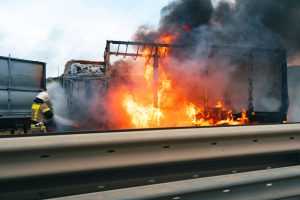
Commercial trucks are more likely than passenger vehicles to catch on fire after an accident.
At Least One Dead, Highway Shut Down After 18-Wheeler Explodes on I-35 North
According to a KENS5 News report, at least one person is dead and major traffic delays affected commuters after a truck explosion early Friday morning.¹
Police reported the incident happened around 8 a.m. Friday, November 20th, on northbound I-35 near Judson and Toepperwein Roads, just outside Live Oak on San Antonio’s Northeast Side.
Early reports indicated that an 18-wheeler exploded on the highway, killing at least one person and forcing authorities to shut down the main lanes.
It remains unclear what caused the explosion or whether any other vehicles were involved.
Video submitted by viewers showed thick, black smoke rising from the scene, where the 18-wheeler appeared to have fallen onto the highway from the frontage road.
There was no immediate word on when the highway would reopen.
The investigation is ongoing.
Did You Know?
According to FMCSA data, 464 people have died in Texas traffic crashes involving at least one commercial truck so far in 2026.²
Why Can an 18-Wheeler Crash Turn Into a Fire or Explosion?
Seeing smoke pouring from an 18-wheeler on the highway is frightening for anyone nearby. When that fire happens after a crash, the danger can escalate quickly for the truck driver, people in surrounding vehicles, and the emergency crews trying to reach them.
Commercial trucks are much larger and more complex than ordinary passenger vehicles. They carry substantial amounts of fuel, have heavy-duty braking and electrical systems, and sometimes transport cargo that creates additional hazards when damaged.
That does not mean every truck fire has the same cause. In fact, figuring out why the truck crashed and why it caught fire can require two separate questions.
A mechanical failure might cause the initial crash, for example, while the force of the impact ruptures a fuel tank and starts the fire afterward. In another accident, the fire itself could begin with an overheated or failed truck component.
Fuel Tanks Can Be Damaged in a Serious Crash
An 18-wheeler carries far more fuel than the average passenger car, and a violent impact or rollover can damage the tanks, fuel lines, or their connections.
If diesel begins leaking near a hot engine component, sparks, or another ignition source, a fire can start and spread beyond the truck itself.
Diesel is less easily ignited than gasoline, but that does not make a large fuel leak harmless. Once a fire starts, the amount of fuel involved can make the scene much more difficult and dangerous for everyone nearby.
Mechanical Problems Can Start Before the Crash
Not every truck fire starts because something hit the fuel tank. Sometimes, the problem begins inside the truck itself.
Commercial trucks put enormous stress on their brakes, tires, wheel bearings, electrical systems, and other components. When those parts are poorly maintained or fail on the road, they can create both a fire risk and a crash risk.
For example, dragging or overheated brakes can generate extreme heat, while a failed wheel bearing or electrical problem can create another source of ignition.
This is why maintenance is critical. Trucking companies are responsible for keeping commercial vehicles safe to operate, and a serious mechanical problem should not be ignored until something goes wrong on the highway.
If poor maintenance contributes to a crash or fire, the company in charge of maintenance can also bear responsibility.
Hazardous Cargo Can Add Another Layer of Danger
Some commercial trucks carry flammable liquids, gases, chemicals, or other hazardous materials. When that type of cargo is involved, a collision can become much more dangerous if a container breaks open or begins leaking.
Federal safety rules govern how hazardous materials must be packaged, labeled, secured, and transported.
When hazardous cargo is involved in a truck fire, investigators will look closely at what was being transported, how it was secured, and whether the applicable safety rules were followed. Those details can help explain how the fire spread and whether problems with the cargo contributed to the severity of the accident.
Sometimes the Crash Causes the Fire
A major collision can damage several parts of a truck at once.
Fuel lines can break. Electrical wiring can be crushed or torn apart. Tires and mechanical components can be exposed to intense heat and friction.
That is why the cause of the accident and the cause of the fire are not always the same.
Imagine that a tire suddenly fails and causes an 18-wheeler to roll. The tire failure may have caused the crash, while damage from the rollover causes fuel to leak and ignite afterward.
In a case like that, simply determining where the flames started would not explain why the accident happened in the first place. Both parts of the event have to be investigated.
A Truck Fire Can Make an Already Serious Crash Much Worse
Anyone who has ever driven beside an 18-wheeler knows just how much larger these vehicles are than the cars around them. A serious collision already creates the risk of devastating injuries, but fire introduces an entirely different set of dangers.
Victims can suffer:
- Severe burns that require surgeries, skin grafts, and long-term treatment
- Smoke inhalation that damages the lungs and causes lasting breathing problems
- Delayed rescue when flames, intense heat, or the risk of another explosion prevents emergency crews from immediately reaching someone
- Additional collisions when smoke, debris, or spilled material creates another hazard for approaching motorists
- Permanent injuries including scarring, disfigurement, nerve damage, and chronic pain
Those injuries can affect someone for years after the highway has reopened and the damaged vehicles are gone.
Fire also creates another problem that is easy to overlook: it can destroy evidence.
Parts of the truck that might have shown a mechanical failure, defective component, or maintenance problem can be badly damaged in the flames. That makes the evidence that survives even more important when investigators are trying to determine what went wrong.
Who Can Be Responsible for an 18-Wheeler Fire Accident?
Truck accidents are rarely as simple as exchanging insurance information with another driver.
The driver may have made a mistake, but the trucking company could also have failed to maintain the vehicle. A repair company could have performed bad work. A defective truck part could have failed. Improperly loaded cargo could have contributed to the crash, or another driver on the road could have triggered the entire chain of events.
Depending on what happened, responsibility can involve:
- The truck driver
- The trucking company
- A maintenance or repair company
- A truck or parts manufacturer
- A cargo company or loader
- Another negligent driver
- More than one of these parties
Each party may have played a different role in causing the crash or making the fire worse. If those roles are not investigated, an injured person could end up relying on only part of the story and miss important legal rights tied to the companies or people whose actions contributed to what happened.
Why You Should Talk to a Lawyer After an 18-Wheeler Accident
A crash with an 18-wheeler is different from an ordinary fender-bender, even when you are fortunate enough to walk away without an obvious injury.
Commercial trucks are backed by trucking companies and commercial insurance policies, and those companies know how much can be at stake after a serious accident. Their insurers may begin investigating almost immediately, which means they are already working to protect their interests while you are still trying to figure out what happened.
That is why speaking with an experienced truck accident lawyer is a smart step after a collision with an 18-wheeler, even if you are not yet sure whether you have a major claim.
A lawyer can help protect you when:
- You were injured or begin developing symptoms after the crash. Some injuries are obvious immediately, while others become more noticeable in the hours or days that follow. A lawyer can help make sure you do not settle your claim before you understand the full effect the accident has had on your health.
- Your vehicle suffered major damage. A truck crash can leave you with repair costs, a totaled vehicle, rental expenses, and other financial losses even when you escape serious injury. A lawyer can review what compensation is available instead of leaving you to accept whatever the commercial insurer initially offers.
- The trucking company or insurer is already investigating. Their investigation is designed to protect their side of the claim. Having your own lawyer means someone is protecting your interests, preserving evidence, and making sure the trucking company’s version of events is not the only one that matters.
- More than one company may be responsible. Trucking companies, maintenance providers, manufacturers, cargo companies, and other businesses can all play a role in the same accident. A lawyer can investigate each party and pursue every available source of compensation instead of allowing one company to shift responsibility elsewhere.
- You are being blamed for the crash. Commercial insurers have a strong financial reason to reduce the amount they have to pay. If they try to put unfair blame on you, a lawyer can act as your advocate and use the evidence to protect your right to compensation.
- Someone was seriously injured or killed. When the consequences are severe, so is the amount at stake. A lawyer can protect your rights, determine the full value of the claim, and make sure long-term medical needs or wrongful death losses are not overlooked.
You do not have to know exactly what your case is worth before speaking with a lawyer. In fact, that is one of the reasons to call.
A truck accident lawyer can look at what happened, explain what rights and compensation you have, and help you decide what makes sense before you sign paperwork, give a recorded statement, or accept money from the trucking company’s insurer.
Injured or Lost a Loved One in an 18-Wheeler Accident? Call Shaw.
A serious truck crash can leave you dealing with life-changing injuries or the sudden loss of someone you love. When fire or an explosion is involved, figuring out what happened and who was responsible can become even more complicated.
If another person’s or company’s negligence caused the crash, compensation can include:
- Emergency Medical Treatment and Hospitalization
- Burn Treatment and Reconstructive Surgery
- Future Medical Care
- Lost Wages and Reduced Earning Capacity
- Physical Therapy and Rehabilitation
- Pain and Suffering
- Permanent Disability or Disfigurement
- Wrongful Death Damages
- Other Accident-Related Losses
- And More
We’ll help you find out for free.
At Carabin Shaw, we put Clients First. Our experienced truck accident lawyers can investigate what caused the crash, identify every responsible party, protect your rights, and help you pursue the full compensation available under Texas law.
Call Shaw today at 800-862-1260 for a free case evaluation. There are no fees, no obligations, and no pressure, just compassionate legal guidance when you need it most.
We look forward to serving you.