 Texas Accident & Injury News


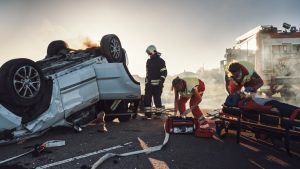
Rollover crashes often end in more serious injuries.
Southside ISD Officer Killed, Two More Injured in Tragic Rollover Crash in Far South Bexar County
According to a News4SanAntonio report, a Southside ISD police officer tragically lost her life and two others were injured in a major accident Sunday morning.¹
Police reported the accident happened just before noon on Sunday, November 15th, at the intersection of South Loop 1604 East and Highway 281 in Far South Bexar County.
A black Southside ISD sedan carrying two off-duty female officers may have been attempting a left turn when it collided with a white pickup truck, causing the sedan to roll over.
All three people involved were transported to the hospital, where one of the Southside ISD officers was pronounced dead.
Southside ISD Superintendent Ronaldo Ramirez later identified her as Officer Christina Lozano. The other officer and the pickup driver were listed in stable condition.
The cause of the accident remains under investigation. No other injuries were reported.
Did You Know?
According to TxDOT data, 955 people were killed in traffic accidents at or related to intersections across Texas in 2025.²
Why Do So Many Serious Accidents Happen at Intersections?
Intersections can feel routine because we drive through them every day. But they are also places where several streams of traffic cross at once, sometimes with only a few seconds separating one driver’s decision from another’s.
That becomes especially dangerous when someone misjudges an approaching vehicle, misses a traffic signal, or tries to squeeze through before the light changes.
Unlike many highway crashes, intersection collisions often involve one vehicle striking the side of another. Because the sides of most vehicles offer less protection than the front or rear, these crashes can cause severe injuries even when they happen at lower speeds.
Understanding why they happen can also make it easier to understand how responsibility is determined afterward.
Left-Turn Accidents
Making a left turn across traffic requires a driver to judge both distance and speed correctly.
Texas law requires a driver turning left to yield to oncoming traffic that is already in the intersection or close enough to create an immediate hazard.³
That sounds straightforward, but real crashes are not always so simple.
A driver may begin a turn believing there is plenty of room, only to discover that the approaching vehicle is moving much faster than expected. In other cases, poor visibility, distraction, or a last-second decision can make an otherwise ordinary turn dangerous.
So while the turning driver may be responsible for failing to yield, they are not automatically responsible for every left-turn collision. If the approaching driver was speeding, ran a light, or made another unsafe move, both drivers’ actions may need to be considered.
Running Red Lights and Stop Signs
Traffic signals only work when drivers actually follow them.
A driver who runs a red light or rolls through a stop sign can enter an intersection directly into another vehicle’s path, leaving the other driver with almost no time to react.
These crashes are especially severe when the impact hits a door instead of the front or rear of the vehicle. A hard side impact can push a vehicle into another lane, spin it around, or even cause it to roll over.
When a driver ignores a traffic signal and causes a crash, that violation can become an important part of determining responsibility.
Speeding
Speeding creates two problems at an intersection.
First, it gives the speeding driver less time to stop or react when something changes ahead.
Second, it makes that vehicle harder for everyone else to judge.
Imagine waiting to make a left turn and seeing a car approaching from a distance. If that driver is traveling much faster than the posted speed limit, the gap that looked safe can disappear much faster than expected.
That is why an intersection accident cannot always be reduced to “one driver turned left, so they must be at fault.” The speed and actions of the other driver matter too.
And when a crash does happen, higher speeds increase the force of the impact and the risk of serious injury.
Distracted Driving
Intersections demand a lot of attention at once.
Drivers are watching lights, checking for approaching vehicles, looking for pedestrians, and deciding when it is safe to move. A few seconds spent looking at a phone or navigation screen can mean missing the one thing that mattered most.
A distracted driver may not notice that the light has changed, that another vehicle has entered the intersection, or that someone ahead has stopped unexpectedly.
By the time they look back up, there may not be enough room left to avoid the collision.
Who Is Responsible for an Intersection Accident?
Sometimes the answer is obvious. Other times, both drivers tell completely different stories about what happened.
That is why determining fault often requires more than asking who technically had the right of way.
Investigators look at traffic-light timing, vehicle speeds, witness statements, dashcam or surveillance footage, skid marks, and vehicle damage to piece together the sequence of events.
Texas also allows responsibility to be divided when more than one person contributes to a crash. If an injured person shares some responsibility, their compensation is reduced by that percentage. If they are found more than 50% responsible, they cannot recover damages at all.⁴
That does not mean everyone involved automatically shares blame. It simply means the evidence should determine responsibility rather than assumptions about who entered the intersection first.
What Compensation Is Available After a Serious Intersection Crash?
Intersection accidents can cause injuries that affect someone long after the damaged vehicles are cleared from the road.
A person may need surgery, months of physical therapy, or time away from work. In fatal crashes, surviving family members can also face both financial loss and the pain of losing someone unexpectedly.
Depending on the circumstances, compensation can include:
- Emergency Medical Treatment
- Hospital Bills and Ongoing Medical Care
- Lost Wages and Reduced Earning Capacity
- Physical Therapy and Rehabilitation
- Pain and Suffering
- Physical Impairment or Disfigurement
- Wrongful Death Damages
- Other Accident-Related Losses
- And More
When Should You Hire a Car Accident Lawyer?
Not every minor accident requires an attorney. If no one is seriously injured, fault is clear, and the insurance company handles the claim fairly, you should be able to resolve it on your own.
But accidents like this one involving rollovers, serious injuries, and fatalities are not that straightforward.
You can always talk to a lawyer no matter the severity of an accident. But as a general rule, you should call a lawyer after a car accident if:
- You suffered serious or permanent injuries. When an injury affects your ability to work, live independently, or return to the life you had before the crash, the value of the claim can be much higher. A lawyer can help make sure your future medical care, lost earning ability, and long-term limitations are fully considered instead of focusing only on the bills you have today.
- Someone was killed in the crash. Wrongful death claims involve higher potential value and special laws and are often hotly disputed. Having a lawyer is critical in this scenario to protect your rights and ensure you receive the full value of the compensation you’re legally entitled to.
- Fault is disputed. When the other driver or insurance company blames you for the crash, that can directly threaten your right to compensation. A lawyer acts as your advocate, using the evidence to challenge false accusations and protect you from being unfairly blamed for someone else’s actions.
- More than one driver may be responsible. Texas allows fault to be divided between multiple people, which can directly affect how much compensation you recover. A lawyer can investigate each driver’s actions and push back against attempts to place more blame on you than the evidence supports.
- The insurance company is blaming you. If an insurer argues that you caused part of the crash, your compensation can be reduced or even eliminated if too much fault is placed on you. A lawyer can challenge those accusations and protect your right to recover the full compensation the evidence supports.
- The insurance company denies the claim or offers far less than your losses. Insurance companies have a financial incentive to pay as little as possible, especially when serious injuries make a claim more valuable. A lawyer can evaluate what your case is actually worth and fight for compensation that reflects the full impact of your injuries, not just the first offer the insurer puts on the table.
- Important evidence could disappear. If the evidence needed to prove what happened is lost, your claim can become much harder to win. A lawyer can move quickly to preserve video, vehicle data, witness statements, and other evidence so you are not left trying to prove your case after the strongest proof is gone.
The point is not that every accident needs a lawyer. It is that when the injuries are serious, fault is disputed, or the financial consequences could follow you for years, getting experienced legal advice before accepting a settlement ensures that insurance companies don’t get away with giving less than the full amount your claim is legally worth.
Injured or Lost a Loved One in an Intersection Accident? Call Shaw.
A serious intersection crash can leave you dealing with injuries, medical bills, lost income, or the sudden loss of someone you love.
If another driver’s negligence caused the accident, compensation may be available for:
- Emergency Medical Treatment
- Hospital Bills and Ongoing Medical Care
- Lost Wages and Reduced Earning Capacity
- Pain and Suffering
- Physical Impairment or Disfigurement
- Wrongful Death Damages
- Other Accident-Related Losses
- And More
We’ll help you find out for free.
At Carabin Shaw, we put Clients First. Our experienced car accident attorneys can investigate the crash, protect your rights, identify responsible parties, and help you pursue the full compensation available under Texas law.
Call Shaw today at 800-862-1260 for a free case evaluation. There are no fees, no obligations, and no pressure, just compassionate legal guidance when you need it most.
We look forward to serving you.
Sources
² TxDOT Texas Motor Vehicle Traffic Crash Facts 2025
³ Texas Transportation Code § 545.152 — Vehicle Turning Left
⁴ Texas Civil Practice & Remedies Code Chapter 33 — Proportionate Responsibility